Showing posts with label global economy. Show all posts

Saturday, 4 February 2012

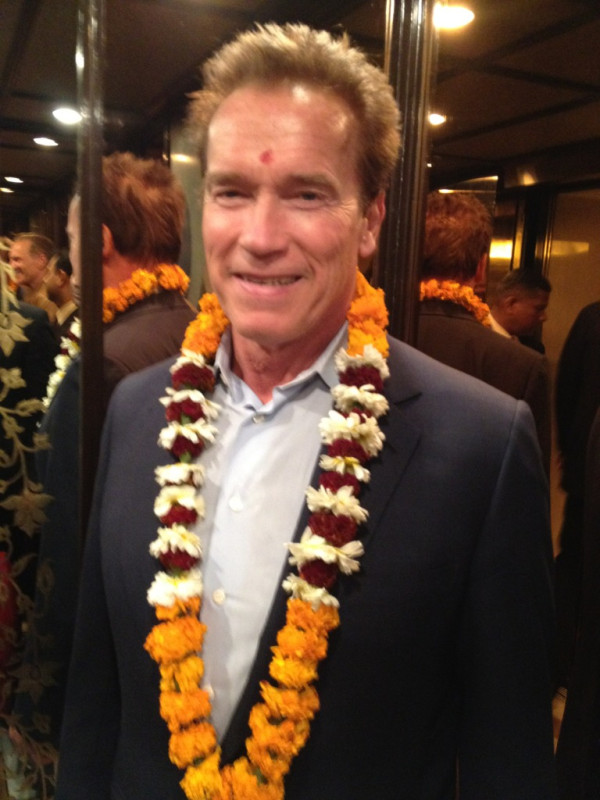
Schwarzenegger telling Indians fairy tales about "booming" green economy in California


 "The measures taken in California have brought the state in the forefront of green movement in the US. Green economy is booming with 10 times more jobs in green sector and 40 percent more energy efficiency."

However, the Terminator appears to have a rather selective view of the "booming" California economy. Here are some facts which he chose not include in his keynote speech:

In the Bay Area as in much of the country, the green economy is not proving to be the job-creation engine that many politicians envisioned. President Obama once pledged to create five million green jobs over 10 years. Gov. Jerry Brown promised 500,000 clean-technology jobs statewide by the end of the decade. But the results so far suggest such numbers are a pipe dream.   
--
Federal and state efforts to stimulate creation of green jobs have largely failed, government records show. Two years after it was awarded $186 million in federal stimulus money to weatherize drafty homes, California has spent only a little over half that sum and has so far created the equivalent of just 538 full-time jobs in the last quarter, according to the State Department of Community Services and Development.      
--
Job training programs intended for the clean economy have also failed to generate big numbers. The Economic Development Department in California reports that $59 million in state, federal and private money dedicated to green jobs training and apprenticeship has led to only 719 job placements — the equivalent of an $82,000 subsidy for each one.

PS
     
Maybe the Terminator was actually thinking about a new kind of "booming" green economy waiting to become reality?:

Last week, more than 200 prisoners at California’s notorious San Quentin State Prison turned out for a “green jobs” fair. The soon-to-be-released felons were greeted by representatives from several nonprofit groups and training programs, all offering advice and information about the ecologically friendly employment opportunities that supposedly await the men beyond the prison's gates.
The inmates of San Quentin also took part in psychobabble discussion groups. An examination of the topics presented included growing your own food will save money; watching plants grow will develop patience; gardening will teach tolerance toward plants and people; and another that literally promised, “smelling the plants changes behavior.”
--
The way utopian-minded non-profits like Planting Justice and Insight Garden Program see the world is, if we’ll just give an ex-con a bag of vegetable seeds upon release, he’ll grow his own food, save money, be more patient and tolerant, his overall behavior will forever be altered, and his criminal ways will be a distant image in the rearview mirror of life.

If only it were so easy.

Forgive me for being cynical, but my antenna is way up. Seems to me, if anything, Planting Justice and the Insight Garden Program may be unknowingly preparing some of these prisoners to become master growers of marijuana and poppy plants.

Read the entire article here

Thursday, 12 January 2012

2012: A hard landing in China and a recession in Germany?

This year may see the Chinese economy crash and Germany sliding into recession. Right now there are not too many bright spots (the American-led shale gas revolution is one) in the global economy:

A looming hard landing in China will bring the financial and economic crisis of the past five years to a climax in 2012, one of the City of London's leading analysts has warned.
Albert Edwards, head of strategy at Société Générale and one of the UK's leading "bears", said the next 12 months would be the "final year of pain and disappointment".
Predicting a sharp slowdown in activity in the world's fastest-growing emerging economy, Edwards said: "There is a likelihood of a China hard landing this year. It is hard to think 2013 and onwards will be any worse than this year if China hard-lands."

Edwards's view was supported by the historian Edward Chancellor, who said China's recent economic performance conformed to the pattern of previous manias and bubbles in history. These included an uncritically assumed growth story, easy money and credit expansion, investment booms and the misallocation of capital, and conspicuous consumption.

Read the entire article here

And China´s hard landing will soon start hurting the German economy. There are already fears about a recession later this year:

The German economy grew strongly last year, despite the European debt crisis. Gross domestic product jumped by 3 percent, while the national deficit sank, the Federal Statistical Office reported on Wednesday. But experts warn that, given the slight contraction in the final quarter of last year, Germany could enter a recession in 2012.


And with Europe´s economic engine running out of steam the last hope for a solution to the eurozone crisis is quickly disappearing ....

Saturday, 30 July 2011

The repercussions of an economic slowdown in China

The Taiwanese know China better than most other people. That is why it is worth reading what Wu Hui-lin, a researcher at the Chung-hua Institution for Economic Research, has to say about the deteriorating trend for China´s small and medium-sized companies, which contribute about 60% to China´s GNP and 80% of urban employment:

It is a well-known fact that China’s economy is going through great structural changes. Small and medium-sized enterprises (SMEs), which make up more than 99 percent of all Chinese companies, require a healthy operating environment and such an environment normally includes free entry to the market, fair competition, a mature and reasonable financial order, a sound legal system, transparent regulations and controls, as well as effective execution. However, for some time now the Chinese operating environment has placed major restrictions on the development of SMEs. In particular, these companies have been treated differently when it comes to financial assistance.

The interest rates on 62.3 percent of loans to SMEs are higher than the benchmark interest rate, while only 27.2 percent of large enterprises are subject to a higher rate. In addition, large enterprises receive more preferential loans. SMEs also tend to have less sound credit, which makes it difficult for them to obtain loans. Now that China is tightening access to credit, SMEs tend to be the first to have their loans put on hold by banks, compounding their already difficult situation.
---
Judging from the situation in China, the manufacturing industry is clearly deteriorating. While it is true that this sector has been affected by the continued appreciation of the yuan, rising raw material prices, rising labor costs and the international financial crisis, the factor that has most directly undermined the manufacturing and -processing industries is the difficulty accessing capital as a result of financial controls and tightening credit.

On April 30, an article in the Chinese magazine Economic Review revealed that many Chinese SMEs are experiencing problems.

Rising costs have led to declining profits and many businesses facing a situation where stopping production will cause them to close, while continued production will lead to an even faster demise. Needless to say, a wave of SMEs are having to close.
One entrepreneur said that the biggest problems for Chinese SMEs is that: “Regardless of whether they are selling to the domestic market or for export, there is a clear shortage of orders and it is very common to see factories running at half capacity and making a loss. Even if they run at full capacity, they will not make any profits to speak of and everyone is doing all they can just to hold on.”
---
Last year, there were more than 10 million registered SMEs in China and the final value of their products and services was equal to about 60 percent of the GDP. They provided 80 percent of urban employment and their tax payments made up 50 percent of all tax revenue. SMEs are clearly vital to China’s economic and social stability, and the current wave of closures will undoubtedly have an impact on the nation.
Now there is increasing talk of the Chinese economy’s possible collapse. Not long ago, “Dr Doom” himself, renowned economist Nouriel Roubini, included China’s demise as one of four factors in a perfect storm. Even those who used to have a bullish outlook are now changing their tune.

Read the entire Taipei Times article here

There are, of course, a number of other factors contributing to the risk of a serious slowdown in China, such as e.g. inflation and the looming real estate bubble.

The slowdown of the Chinese economy will without doubt have major repercussions in other countries as well. From a European point of view, Germany is the country that is going to be hardest hit, considering the importance of China in the German export success of recent years:

China is now Germany´s most important non-European export destination. As the Economist recently pointed out, German firms "happen to produce exactly the things that a booking China wants, from luxury cars to the machinery that enable Chinese factories to be the workshops of the world". Mercedes and BMW e.g. make 40% of their profits in China.

There are already signs of cooling in the German economy:

German investor confidence dropped for a fifth month in July, executives grew less optimistic and manufacturing growth slowed. German consumer confidence will drop for a fifth month in August, a survey by the GfK SE (GFK) market-research company showed on July 26.

Add the euro crisis and the financial turmoil in the US and you have the ingredients of a "perfect storm".

Sunday, 30 January 2011

Czech president Klaus´s global forecast

Czech president Václav Klaus is one the very few politicians, who´s speeches and articles always are interesting to read. In his recent speech at the Com.Sult congress in Vienna Klaus offers the following forecast for the next two years:

1. the European single currency, the Euro, will survive its current acute crisis but we will pay a very high price for it in long-term economic slowdown if not stagnation, in a heavy burden of inter-country fiscal transfers, in the further loss of sovereignty of the EU member states, in increasing centralization of decision-making in Brussels, in a growing democratic deficit;
2. eurodebt crisis à la Greece or Ireland will reach other eurozone countries. The costs of helping them will be increasing but these costs will be – reluctantly and unwillingly – paid by the tax-payers in the rest of the EU;
3. economic growth in Central and Eastern European countries, including the Czech Republic, will be faster than in Western Europe. The gap in the level of economic development between the European East and West will keep diminishing;
4. economic growth in the U.S. will continue to be weak. It will be taken as a disappointment and Obama’s administration will have more and more problems. It becomes clear that – because of structural deficiencies – Obama’s fiscal stimulus cannot rescue the U.S. economy. It stimulates employment more in China and India than in America;
5. global economic growth will continue to depend on new dynamic economies in Asia and Latin America. The BRIC countries will grow fast and their catching-up process will continue. The BRIC economies as a group are practically as important to the global economy as the United States economy already now and their role in the world economy will grow.

Read the entire speech here. The analysis in the first part of the speech is strongly recommended reading.

The climate in Europe is deinitively changing.. which is proved by the fact that at the Vienna Congress the whole audience (700 participants) applauded loudly and were shouting "bravo" after President Klaus said the following sentense: "As someone who spent almost fifty years living in an oppressive, visibly irrational and hopelessly inefficient communist system, I hope I can afford to say that I see more similarities between communism and the current EU than it is considered politically correct to admit".


My comment to Klaus´s points:

"Mrs. Merkel and I will never, never allow the Euro to fail"
 Nicolas Sarkozy


"Let me say this very clearly again. The euro is our currency. And it is much more than just a currency. It is the embodiment of Europe today. Should the euro fail, Europe will fail"
Angela Merkel  

If one considers what Merkel and Sarkozy said a couple of days ago in Davos, Klaus´s (from a eurorealist point of view) rather pessimistic forecast looks very plausible, but I think there is another scenario that may lead to an accelerated demise of the euro in its current form. This scenario takes a more pessimistic view of the development in China as its point of departure:

It now seems very likely that the Chinese property bubble will burst in the near future, causing huge problems for countries now relying on exports to China.

The present strong economic growth in Germany - the euro paymaster - is very dependent on exports to China. A crisis in the Chinese economy would thus have major repercussions for Germany (and of course many other countries). In that kind of a situation Germany will - despite Merkel´s and Sarkozy´s fine words in Davos - not hesitate to change its attitude towards the common currency. An entirely new ballgame would follow. It could lead to the formation of e.g. a "Northern euro" consisting of those countries that are capable of playing on the same level as Germany, or some other similar arrangement.