One of the European Union´s two - soon to be three - unelected "presidents", former Portuguese maoist José Barroso today once again showed his arrogance and utter contempt for democratically elected leaders:
PS
Barroso, who once called the EU an empire, appears to think that he is some kind of a mini-emperor with the right to rebuke democratically elected heads of state and government. It is hight time that somebody finally tells him to shut up.
Thursday, 8 December 2011

Quote of the week
"Corporations don't exist without people and without the planet."
Beatriz Perez, Vice President and Chief Sustainability Officer, The Coca-Cola Company
(At COP 17 side event in Durban)
"In Praise of Euroskeptics"
Robert Taylor´s "In Praise of Euroskeptics" is definitevely recommended reading:
Euroskeptics have been through it, both in Britain and elsewhere. The haughty laughter, the insults, the patronizing comments, like "little Englander," suggesting both stupidity and insularity. Despite the fact, or perhaps because, Margaret Thatcher was the biggest and most famous euroskeptic of the lot, "euroenthusiasts," among them Tony Blair, took every opportunity to suggest that our argument was based on emotion rather than reason.
In fact the reverse was true. Euroskeptics realized that it was crazy to have a single exchange rate and interest rate applied to somewhere as massive and diverse as the European Union. For unlike Americans we Europeans share no common loyalty to our Union. There is no sense of European nation, and therefore no intrinsic acceptance that our own countries within the Union should be prepared to accept economic hardship for the wider good. Quite the reverse; each country is in it precisely for what it can get out.
To ignore this self-evident reality was Europe's big mistake, even if it took more than a decade to show just how big. Simply, economic union requires political union. And you can't sustain that without the will of the people.
But there is the prospect of an even bigger crisis, if the EU leaders decide to "save" the euro:
Now European leaders are poised to decide whether to forge fiscal as well as monetary union. If they do so, thereby saving the euro, the world will no doubt sigh with relief as short-term catastrophe is avoided.
Yet celebration might be premature. The drive towards ever-closer union has already caused one crisis. The next could be even worse.
Read the entire article here
Euroskeptics have been through it, both in Britain and elsewhere. The haughty laughter, the insults, the patronizing comments, like "little Englander," suggesting both stupidity and insularity. Despite the fact, or perhaps because, Margaret Thatcher was the biggest and most famous euroskeptic of the lot, "euroenthusiasts," among them Tony Blair, took every opportunity to suggest that our argument was based on emotion rather than reason.
In fact the reverse was true. Euroskeptics realized that it was crazy to have a single exchange rate and interest rate applied to somewhere as massive and diverse as the European Union. For unlike Americans we Europeans share no common loyalty to our Union. There is no sense of European nation, and therefore no intrinsic acceptance that our own countries within the Union should be prepared to accept economic hardship for the wider good. Quite the reverse; each country is in it precisely for what it can get out.
To ignore this self-evident reality was Europe's big mistake, even if it took more than a decade to show just how big. Simply, economic union requires political union. And you can't sustain that without the will of the people.
But there is the prospect of an even bigger crisis, if the EU leaders decide to "save" the euro:
Now European leaders are poised to decide whether to forge fiscal as well as monetary union. If they do so, thereby saving the euro, the world will no doubt sigh with relief as short-term catastrophe is avoided.
Yet celebration might be premature. The drive towards ever-closer union has already caused one crisis. The next could be even worse.
Read the entire article here
Wednesday, 7 December 2011
Yet another president for the EU?
Merkozy´s letter to "president" van Rompuy is now public and discussed by various pundits. My only comment relates to the the paragraph in the latter that is called "A strengthened institutional architecture".
• Regular summits – at least twice a year - of the Euro area heads of State and Government with a permanent president. These summits will provide strategic orientations on the economic and fiscal policies in the euro area. The impact of our domestic economic and fiscal policies on the euro area should be considered as a matter of common interest, while safeguarding national responsibility.
That means that the European Union (or at least the eurozone) will have yet another permanent president (presumably with a huge staff to assist him - and maybe also a new building to house it). What a wonderfully creative and totally unexpected solution! Although I am not certain that haiku Herman and his colleague, the former maoist Barroso will be thrilled by the prospect of yet another rival arriving on the scene.
• Regular summits – at least twice a year - of the Euro area heads of State and Government with a permanent president. These summits will provide strategic orientations on the economic and fiscal policies in the euro area. The impact of our domestic economic and fiscal policies on the euro area should be considered as a matter of common interest, while safeguarding national responsibility.
That means that the European Union (or at least the eurozone) will have yet another permanent president (presumably with a huge staff to assist him - and maybe also a new building to house it). What a wonderfully creative and totally unexpected solution! Although I am not certain that haiku Herman and his colleague, the former maoist Barroso will be thrilled by the prospect of yet another rival arriving on the scene.
The European Union in Durban
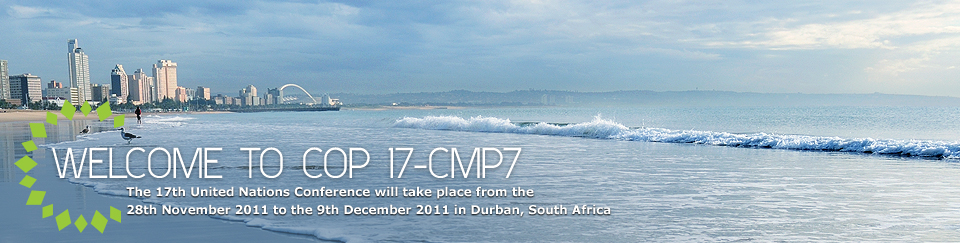
The European Union is, as expected, contributing significantly to make the Durban COP 17 climate change jamboree a success - for airlines offering first and business class flights and the Durban luxury hotels. Nobody will probably know exactly how many official EU
The European Parliament already has a delegation of 15 MEP:s (plus a number of assistants) in Durban, led by the German social democrat Jo Leinen:
Delegation members
Chair Jo Leinen (S&D, DE), Vice-chair Karl-Heinz Florenz (EPP, DE), Kriton Arsenis (S&D, EL), Bairbre De Brún (GUE/NGL, UK), Pilar Del Castillo (EPP, ES), Bas Eickhout (Greens/EFA, NL), Elisabetta Gardini (EPP, IT), Dan Jørgensen (S&D, DK), Corinne Lepage (ALDE, FR), Vladko Panayotov (ALDE, BG), Anna Rosbach (ECR, DK), Oreste Rossi (EFD, IT), Richard Seeber (EPP, AT), Francisco Sosa Wagner (unattached, ES) and Marita Ulvskog (S&D, SE)
The MEP:s will certainly have excellent opportunities to enjoy "side events" on the beach - their official Durban schedule does not appear to be overwhelming:
In their Durban programme, MEPs will discuss negotiations with the Commission and Polish Presidency, meet counterparts from other parliaments (Japan, South Africa and Mexico), as well as local and international NGO representatives.
The taxpayers of Europe wish the European Parliament delegation a nice stay in Durban! Don´t forget the sun tan lotion!
Fighting "climate change" in Papua New Guinea - courtesy of Australian taxpayers
The European Union, the US and many other governments are spending millions and millions of euros and dollars on "fighting climate change" in many of the world´s poor areas. Here is an example of what has been achieved, in this case through the generosity of the Australian taxpayers (via AUSaid):
PS
The playing and singing is not at all bad, but hopefully the AUSaid team will provide the group with some more interesting lyrics ...
How about e.g. Waltzing Matilda?
China´s communist rulers trying to find "a complete mechanism for social management" against protests
The number of strikes and protests are increasing in China, and the countries communist rulers do not seem to know what to do. So far their main approach to the growing problem has been the usual one - ordering the country´s wast security machinery to clamp down on the protesters by using force. The corrupted ruling elite may succeed in this for a while, but when the number of protests keeps growing, the likelyhood that the rulers will find "a complete mechanism for social management,” is not very great .....
Tens of thousands of factory workers in southern Guangdong province employed in the footwear, garment, watchmaking, furniture and electronics industries have taken strike action in recent weeks. Public and municipal sector workers have also taken strike action in Nanjing (public sanitation workers) and Shanghai (public hospital staff). In the Sichuan capital, Chengdu, several hundred state-owned enterprise (SOE) workers staged a three-day (28-30 November) sit-in protest over a share distribution plan following privatisation of the factory.
Around 100 staff blocked and barricaded a supermarket owned by British chain Tesco in the Zhejiang city of Jinhua. The store is to close and workers are fighting for unpaid wages. Bus drivers and taxi drivers have been involved in separate stoppages over low pay and unfair competition in Shandong, Hainan and Guangxi provinces.
Some recent strikes “showed a new level of sophistication” according to Geoffrey Crothall, a commentator for the Hong Kong-based China Labour Bulletin. A good example of this is the coordinated one-day strike by several thousand workers at five of PepsiCo’s 24 plants. The workers – at factories in Chongqing, Chengdu, Fuzhou, Lanzhou and Nanchang – protested last month at PepsiCo’s decision to sell its China arm to Taiwanese-owned Tingyi, fearing that existing terms and conditions of work will be undermined by the deal.
PepsiCo workers made use of weibo micro-blogging sites to publicise their dispute, again underlining a high degree of planning and coordination, which is sorely needed in the struggle for workers’ rights in China. So afraid were the authorities of this example, that ‘Pepsi’ was added to the list of blocked words on internet search engines.
Police and local government officials have generally taken a tough line towards recent disputes, as in the case of the Hi-P strike in Shanghai. Ten workers at the huge Yucheng shoe factory in Dongguan were injured when police cracked down on a protest march involving thousands last month (see: Upsurge of strikes in southern China).
The recent upturn in strikes has sounded alarm bells within the summits of the ‘communist’ dictatorship. Zhou Yongkang, China’s top security official, warned earlier this week about the spectre of social unrest arising due to the state of the economy.
“Especially when facing the negative effects of the market economy, we still have not formed a complete mechanism for social management,” Zhou said. How to do so, he said, “is the great and urgent task before us.”
Read the entire article here
(The site is not exactly my cup of tea, but on this subject I think their reporting is sound)
Tens of thousands of factory workers in southern Guangdong province employed in the footwear, garment, watchmaking, furniture and electronics industries have taken strike action in recent weeks. Public and municipal sector workers have also taken strike action in Nanjing (public sanitation workers) and Shanghai (public hospital staff). In the Sichuan capital, Chengdu, several hundred state-owned enterprise (SOE) workers staged a three-day (28-30 November) sit-in protest over a share distribution plan following privatisation of the factory.
Around 100 staff blocked and barricaded a supermarket owned by British chain Tesco in the Zhejiang city of Jinhua. The store is to close and workers are fighting for unpaid wages. Bus drivers and taxi drivers have been involved in separate stoppages over low pay and unfair competition in Shandong, Hainan and Guangxi provinces.
Some recent strikes “showed a new level of sophistication” according to Geoffrey Crothall, a commentator for the Hong Kong-based China Labour Bulletin. A good example of this is the coordinated one-day strike by several thousand workers at five of PepsiCo’s 24 plants. The workers – at factories in Chongqing, Chengdu, Fuzhou, Lanzhou and Nanchang – protested last month at PepsiCo’s decision to sell its China arm to Taiwanese-owned Tingyi, fearing that existing terms and conditions of work will be undermined by the deal.
PepsiCo workers made use of weibo micro-blogging sites to publicise their dispute, again underlining a high degree of planning and coordination, which is sorely needed in the struggle for workers’ rights in China. So afraid were the authorities of this example, that ‘Pepsi’ was added to the list of blocked words on internet search engines.
Police and local government officials have generally taken a tough line towards recent disputes, as in the case of the Hi-P strike in Shanghai. Ten workers at the huge Yucheng shoe factory in Dongguan were injured when police cracked down on a protest march involving thousands last month (see: Upsurge of strikes in southern China).
The recent upturn in strikes has sounded alarm bells within the summits of the ‘communist’ dictatorship. Zhou Yongkang, China’s top security official, warned earlier this week about the spectre of social unrest arising due to the state of the economy.
“Especially when facing the negative effects of the market economy, we still have not formed a complete mechanism for social management,” Zhou said. How to do so, he said, “is the great and urgent task before us.”
Read the entire article here
(The site is not exactly my cup of tea, but on this subject I think their reporting is sound)
Subscribe to:
Posts (Atom)